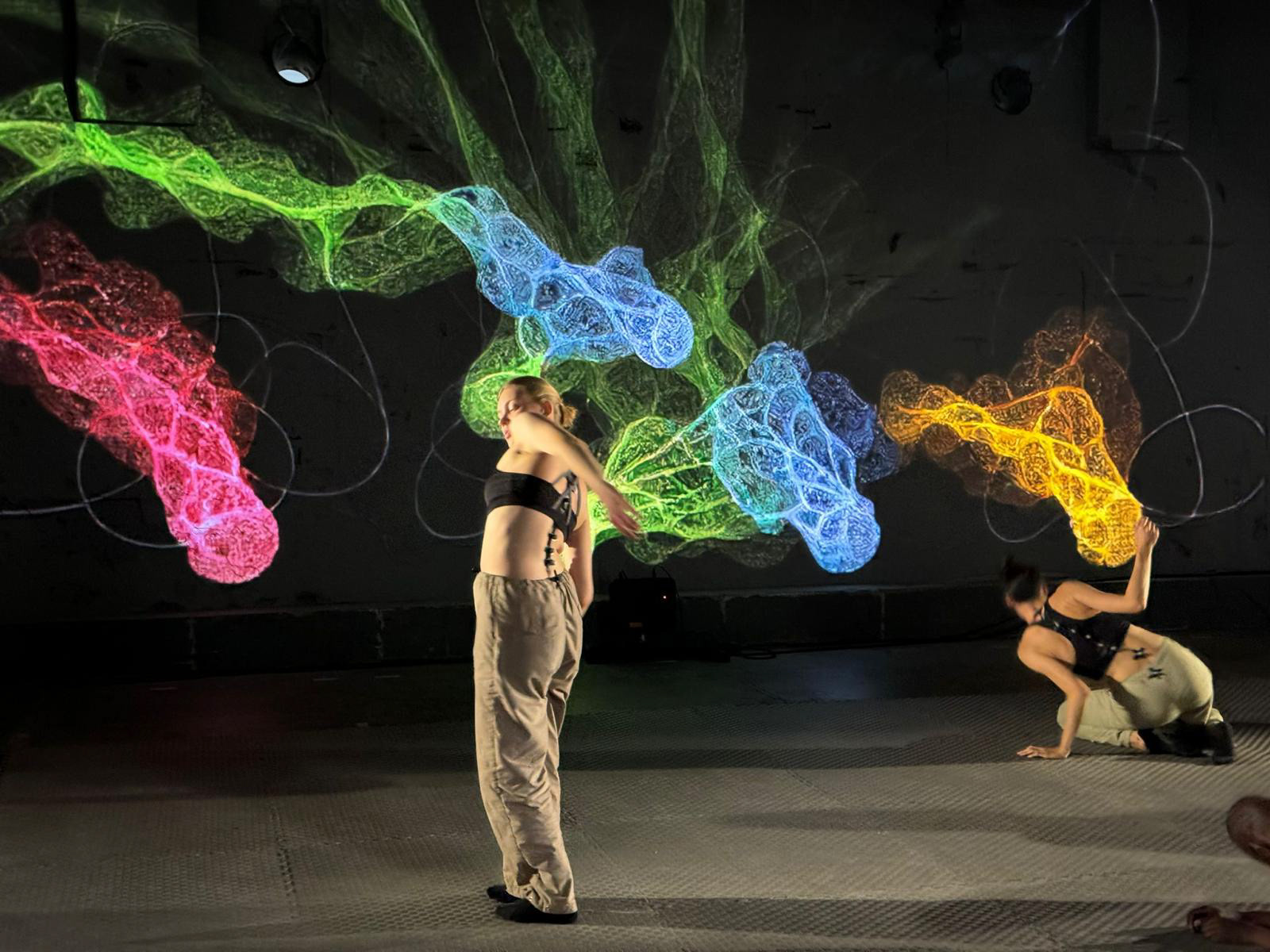
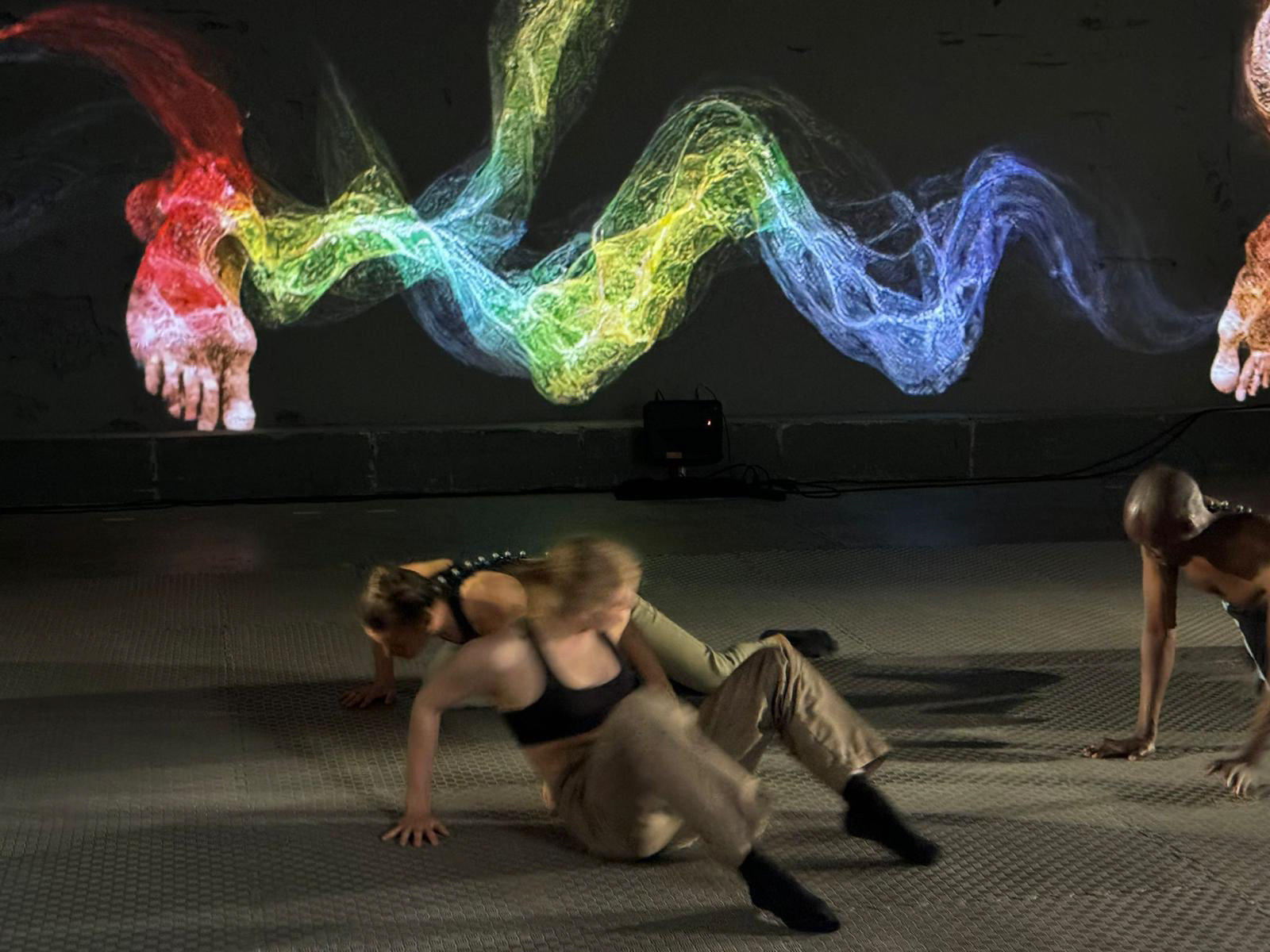
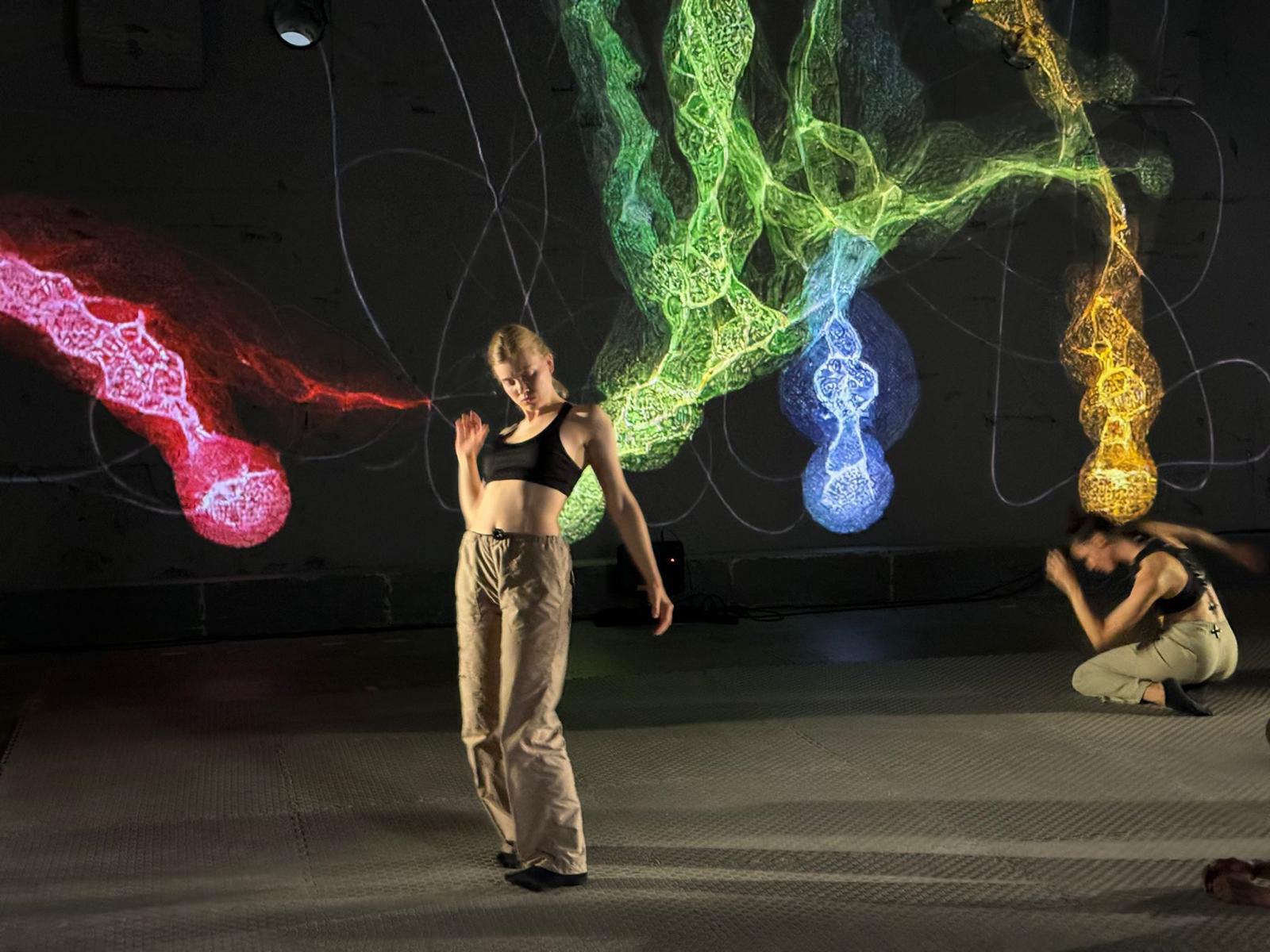
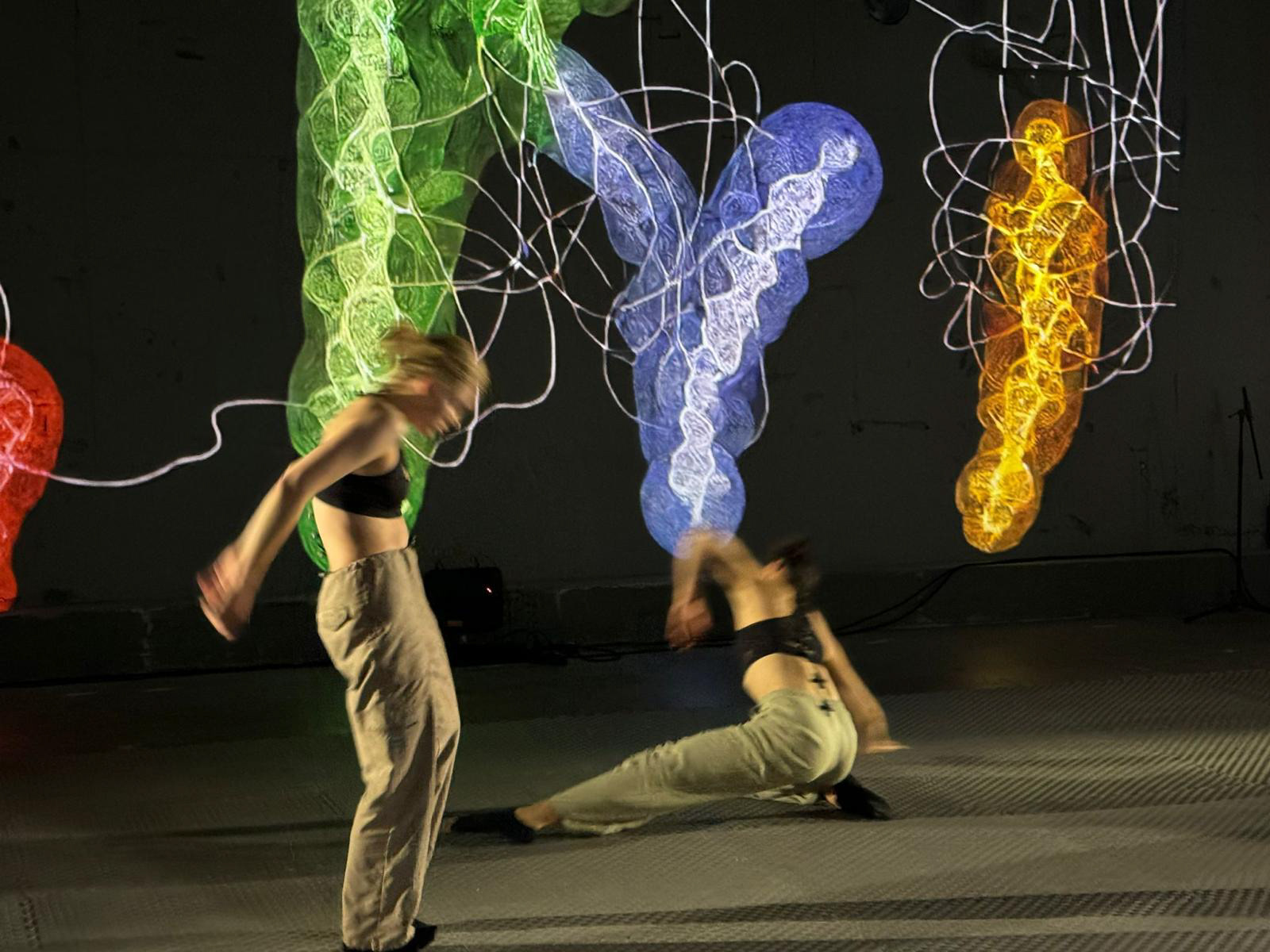
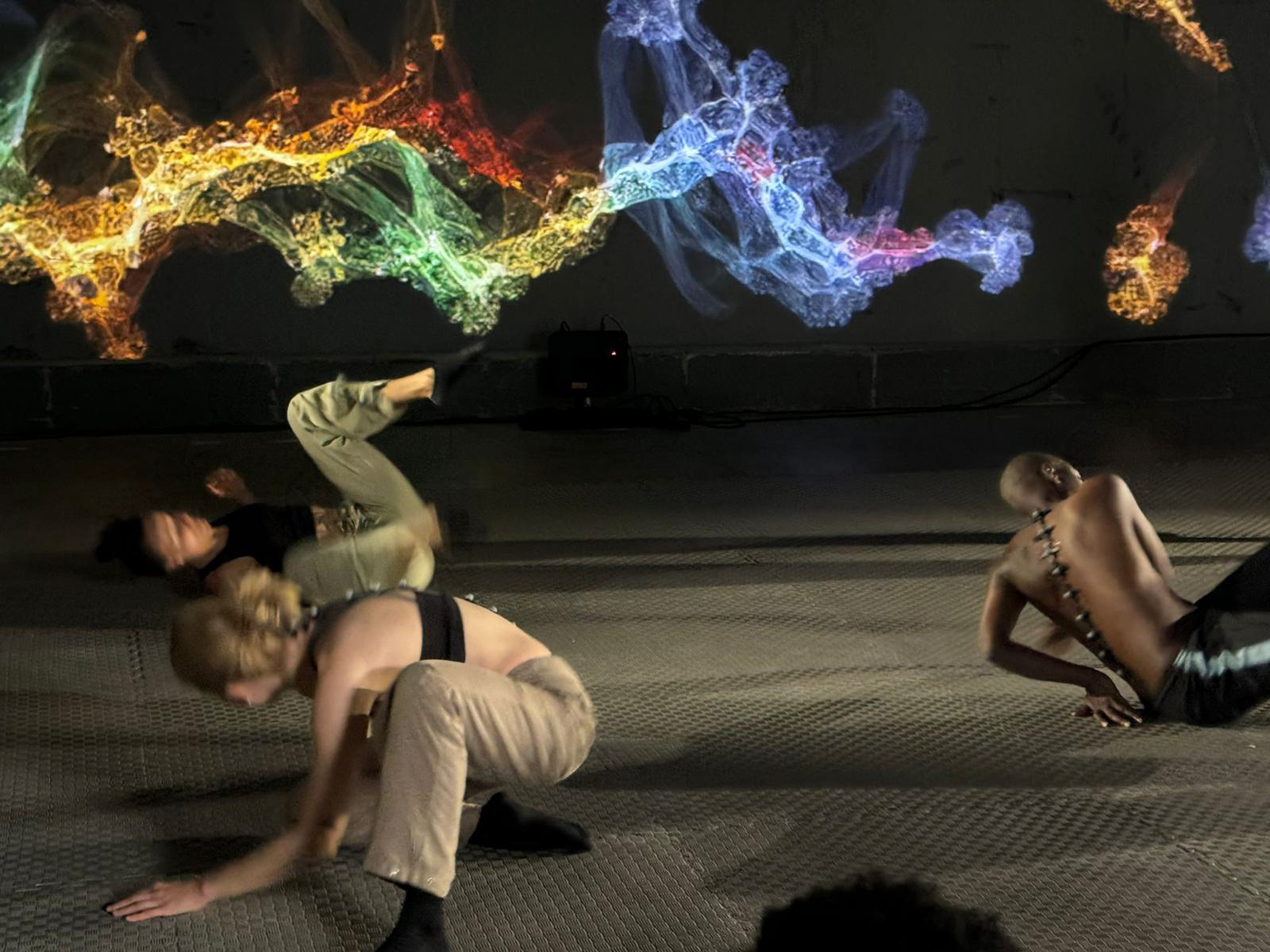
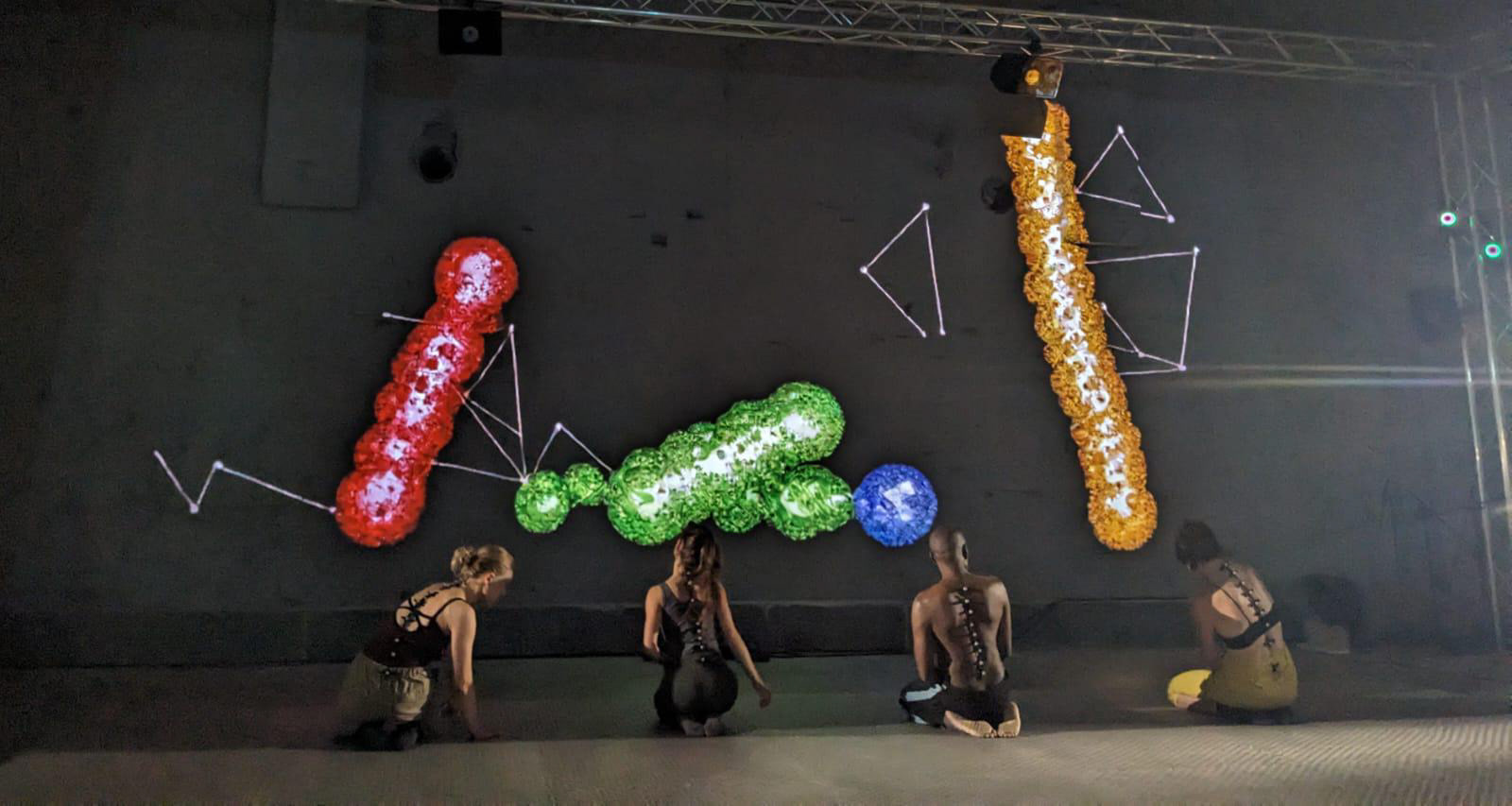
What could the vertebral column have to do with dance and artificial neural networks. That is the territory between art, science and technology we are navigating in the project ‘Psychoactive Surface’ a creative collaboration between myself, the neurophysicist Niklas Fricke - Luna Ring, sound artist Nico Espinoza and the Ai research team at Champalimaud warehouse.
'We often hear how AI should serve humanity as a tool, and presently it is widely used to manipulate us. But can the relationship be of a different kind, a creative and playful one, where one inspires the other without striving for control? Can AI be an instrument rather than a tool, a dance partner rather than a manipulator, a wild horse rather than a slave?
In this interactive installation, human motion and music are coupled to generative visual AI algorithms. Multiple human and AI systems engage in this feedback loop, co-creating fantastic audio-visual dreamscapes. At the boundary between control and letting go, each side may learn to interpret and inspire the other, giving room for unforeseeable emergent phenomena' - Nicklas Fricke.
In this interactive installation, human motion and music are coupled to generative visual AI algorithms. Multiple human and AI systems engage in this feedback loop, co-creating fantastic audio-visual dreamscapes. At the boundary between control and letting go, each side may learn to interpret and inspire the other, giving room for unforeseeable emergent phenomena' - Nicklas Fricke.
With Solène Sautory, Caroline Haimerl, Maria Keridon and Beatriz Belbut we weave, leave traces in space, engage artificial neural networks as extensions of our spines.
The sound in this project is propagated through a multiple speaker set-up not reproducible here. It serves as sonic environment. I have deliberately muted part of the audio of this sequence to give the audience the possibility to see the dance through their own choice of music.
Music often informs the way we see dance while dance equally informs the way we hear music. In this performance we do not dance to music. The bodies generate their own musicality. Don’t worry about synchronicity. I’m counting on our innate abilities to match things and create order. Are the things we perceive around us extensions of our senses? projections of our intuition?
Solène, Caroline, Maria and Beatriz are neuroscientists and cancer researchers at Champalimaud Centre in Lisbon. They have been participating in the research process after hours. Over a few evenings I’ve shared with them somatic practice designed to stimulate heightened state of sensorial awareness & consciousness. We focussed on the zone of the vertebral column between the cervical and sacrum as a sensor for feeling and navigating space; a motor for generating movement and states of body. But also as a compositional tool for framing the dance, interacting with each other, engaging the audience as well as the spatial and sonic environments.
In this sequence we’ve placed markers along our spinal columns, a sort of prosthetic augmentation of the body that the motion tracking system can follow. How do we adapt the tracking system to the specific needs of the choreographic exploration rather than the other way round? How does data from the tracking system meaningfully translate to input in Ai neural networks. How do we find language that enables us to engage and interact with the Ai generated visuals in real-time? Is the Ai system just a mirror we control with our gestures or is it actually controlling us in streams of generic feedback loop? What is the nature of the relationship? exploitative, master/slave? Can the Ai be a dance partner, sculpture, object, scenography?
From a choreographic perspective what are the places of sense, intuition, justness, reason & logic, emotion & feeling in the making & experience of a contraction, posture, gesture, an image, a shift of direction, a suspension, a fall, a displacement…left, right, centre, extreme far…
For Niklas Fricke and the neuroscience team what are the implications in the conception of potential digital therapies…